NAD+ — Scientific background
Nicotinamide Adenine Dinucleotide • Cellular Energy & Metabolic Research
Scientific background describes the compound, not verified results or quality claims for the supplied vial. Research purposes only; not for human consumption. No self-administration or injection. Research findings do not guarantee individual results.
NAD+ (nicotinamide adenine dinucleotide) is a naturally occurring coenzyme found in virtually every living cell. It plays a fundamental role in cellular energy production, redox reactions, mitochondrial metabolism, DNA repair and cellular signalling.
Unlike peptides such as GHK-Cu or MOTS-c, NAD+ is not a peptide. It is a dinucleotide composed of two nucleotides joined together and is an essential component of cellular metabolism.
NAD+ has become an important subject of research into cellular ageing, mitochondrial function, metabolic health and the biology of cellular repair.
What Is NAD+?
NAD+ consists of two components:
Nicotinamide + Adenine dinucleotide
The "+" indicates the oxidized form of NAD.
NAD exists primarily in two forms:
NAD+ ↔ NADH
This reversible relationship allows NAD to act as an important electron carrier in cellular metabolism.
NAD+ & Cellular Energy
One of NAD+'s most important functions is its involvement in the production of cellular energy.
During metabolism, NAD+ accepts electrons and hydrogen to form NADH.
NAD+ → NADH
NADH can subsequently donate electrons to the mitochondrial electron transport chain.
This contributes to:
Nutrients → Electron transport → Proton gradient → ATP production
ATP is the primary energy currency used by cells.
Because of this role, NAD+ is closely associated with mitochondrial energy metabolism.
NAD+ & Redox Biology
NAD+ is a central component of the cellular redox system.
The NAD+/NADH ratio helps regulate the balance between oxidation and reduction reactions throughout the cell.
These reactions are involved in:
- Glucose metabolism
- Fatty-acid metabolism
- Mitochondrial respiration
- Energy production
- Cellular signalling
Maintaining appropriate NAD+ availability is therefore important for normal cellular metabolism.
NAD+ & DNA Repair
NAD+ is also a substrate for enzymes involved in cellular signalling and DNA repair, particularly the sirtuin and PARP families.
Sirtuins
Sirtuins are NAD+-dependent enzymes involved in processes including:
- Cellular stress responses
- Metabolic regulation
- Mitochondrial biology
- Gene regulation
- Cellular ageing research
PARPs
Poly(ADP-ribose) polymerases, or PARPs, use NAD+ during processes associated with DNA damage responses and repair.
This is one reason NAD+ has attracted significant interest in the study of cellular ageing and longevity biology.
NAD+ & Ageing Research
NAD+ levels and metabolism have been extensively investigated in relation to ageing.
Research has suggested that NAD+ availability can change with age and that alterations in NAD+ metabolism may be associated with:
- Mitochondrial dysfunction
- Cellular stress
- Reduced metabolic flexibility
- Changes in DNA-repair activity
- Age-associated cellular changes
This has led researchers to investigate strategies for influencing NAD+ metabolism through NAD+ itself and NAD+ precursors, including nicotinamide riboside (NR) and nicotinamide mononucleotide (NMN).
However, claims that NAD+ supplementation "reverses ageing" or produces guaranteed longevity benefits are not established by current clinical evidence.
Areas of Research
NAD+ is being investigated across a broad range of biological fields:
- Cellular energy production
- Mitochondrial function
- Redox biology
- DNA repair
- Cellular stress responses
- Metabolic regulation
- Sirtuin biology
- Ageing research
- Cellular signalling
- Neurobiology
Product Information
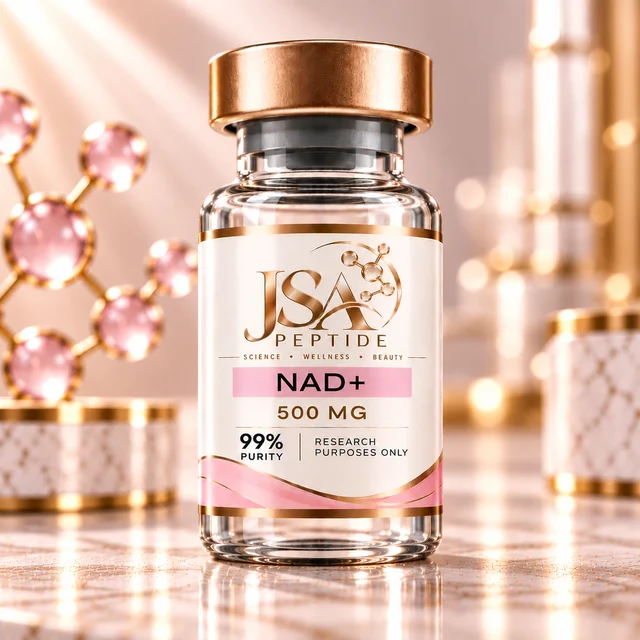
Compound: NAD+
Full name: Nicotinamide adenine dinucleotide
Classification: Dinucleotide coenzyme
Primary forms: NAD+ / NADH
Primary role: Electron transfer & cellular metabolism
Research areas: Energy metabolism, mitochondrial biology, redox regulation and cellular ageing
Important distinction
NAD+ is not a peptide.
It is a naturally occurring coenzyme that participates directly in numerous biochemical reactions.
NAD+ vs NAD+ Precursors
NAD+ should also be distinguished from compounds used by cells to produce NAD+.
Compound Description
NAD+ Active cellular coenzyme
NMN NAD+ biosynthetic precursor
NR NAD+ biosynthetic precursor
Nicotinamide Vitamin B3-related NAD+ precursor
The body's NAD+ pool is continuously produced, consumed and recycled through multiple metabolic pathways.
Why NAD+ Is Scientifically Interesting
NAD+ sits at the intersection of several fundamental biological processes:
Energy metabolism
↓
Mitochondrial function
↓
Redox balance
↓
DNA repair
↓
Cellular signalling
This makes NAD+ particularly interesting to researchers studying how cells respond to energy demand, oxidative stress and ageing-related changes.
Not intended to diagnose, treat, cure or prevent any disease. This information is educational and does not constitute medical advice. Refer to the product’s safety risks above and request batch-specific documentation.