KPV — Scientific background
Lysine-Proline-Valine • Anti-Inflammatory & Skin Research Peptide
Scientific background describes the compound, not verified results or quality claims for the supplied vial. Research purposes only; not for human consumption. No self-administration or injection. Research findings do not guarantee individual results.
KPV is a naturally occurring tripeptide composed of lysine, proline and valine. It is derived from the C-terminal region of α-melanocyte-stimulating hormone (α-MSH) and has attracted scientific interest because of its potential role in inflammatory signalling, immune modulation and skin biology.
KPV is substantially smaller than many therapeutic peptides, consisting of only three amino acids:
Lysine – Proline – Valine
Research has investigated KPV particularly in relation to inflammatory pathways, intestinal biology and dermatological research. However, much of the evidence remains preclinical, and KPV is not an approved therapeutic treatment.
What Is KPV?
KPV is the C-terminal tripeptide fragment of α-MSH.
α-MSH is a naturally occurring peptide involved in several biological processes, including pigmentation, immune signalling and inflammatory regulation.
KPV is of particular scientific interest because some of the biological effects associated with α-MSH appear to be separable from its pigmentation-related activity.
This has led researchers to investigate KPV as a potential non-pigmentary anti-inflammatory signalling molecule.
How KPV Is Being Studied
1. Inflammatory Signalling
KPV has been investigated for its potential influence on inflammatory pathways.
Preclinical studies have examined interactions with pathways involving:
- NF-κB signalling
- Pro-inflammatory cytokines
- Immune-cell activity
- Oxidative stress
- Inflammatory mediator production
These mechanisms have generated interest in KPV as a research tool for understanding inflammatory regulation.
2. Skin & Dermatological Research
KPV has attracted particular attention within skin biology.
Research has investigated its potential relationship with:
- Inflammatory skin responses
- Skin-barrier biology
- Cellular stress
- Immune signalling
- Tissue repair
This has contributed to interest in KPV within cosmetic and dermatological research.
However, laboratory findings should not be presented as proof that KPV treats acne, eczema, rosacea or other skin conditions in humans.
Gastrointestinal Research
KPV has also been studied in experimental models involving the gastrointestinal tract.
Research has explored potential relationships with:
- Intestinal inflammation
- Epithelial-barrier function
- Immune signalling
- Inflammatory cytokines
- Gut inflammatory responses
These studies are primarily preclinical, meaning that findings from experimental models cannot automatically be translated into human therapeutic outcomes.
Relationship With α-MSH
KPV is particularly interesting because it originates from α-MSH.
Simplified:
α-MSH → C-terminal sequence → KPV
While α-MSH is involved in pigmentation and immune regulation, KPV has been investigated for biological effects that may occur independently of melanocortin receptor activation.
This distinction is one of the reasons KPV continues to be studied.
Areas Under Investigation
KPV research includes:
- Inflammatory signalling
- Skin biology
- Dermatological inflammation
- Intestinal inflammation
- Epithelial-barrier function
- Immune modulation
- Oxidative stress
- Tissue-repair biology
These are research areas, rather than established clinical indications.
Product Information
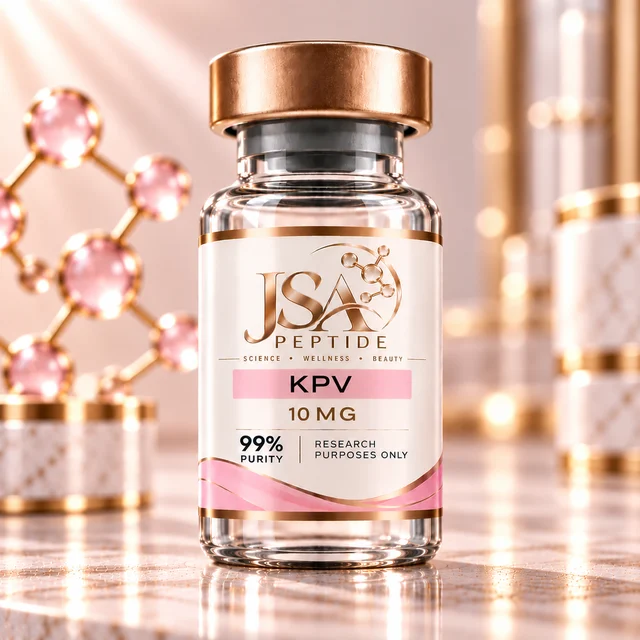
Compound: KPV
Full name: Lysine-Proline-Valine
Peptide type: Tripeptide
Sequence: Lys-Pro-Val
Origin: C-terminal fragment of α-MSH
Research focus: Inflammatory signalling & skin biology
Status: Experimental / investigational
Why KPV Is Scientifically Interesting
KPV is unusual because of its extremely small size.
At only three amino acids, it provides researchers with a simplified model for investigating biological activity associated with larger melanocortin-derived peptides.
Its research profile sits at the intersection of:
α-MSH biology
↓
Immune signalling
↓
Inflammatory pathways
↓
Skin & epithelial biology
This makes KPV particularly relevant to researchers studying the relationship between peptides, inflammation and tissue biology.
Not intended to diagnose, treat, cure or prevent any disease. This information is educational and does not constitute medical advice. Refer to the product’s safety risks above and request batch-specific documentation.